
The three golden opening principles are simple: control the center with your pawns and pieces, develop your knights and bishops quickly, and castle your king to safety early. Follow those three ideas and you will get a healthy position out of the opening without memorizing a single line of theory.
Beginners lose far more games to broken principles than to unknown openings. You do not need to study named systems yet — you need to understand why the first ten moves matter and what good ones look like. Here is the whole framework.

Control the Center
The four central squares — e4, d4, e5, and d5 — are the most valuable real estate on the board. Pieces placed in or aimed at the center control more squares and can shift to either flank quickly.
Start by claiming a central square with a pawn. Moves like 1. e4 or 1. d4 stake a claim in the middle and open lines for your bishop and queen. A knight in the center reaches up to eight squares; the same knight in the corner reaches only two.
Do not neglect the center to grab a wing pawn or chase a small material gain. The side that dominates the middle usually dictates where the game is played.
You do not always have to occupy the center with pawns. Some openings control it from a distance with pieces, letting the opponent build a big pawn center and then attacking it. For your first games, though, the simplest approach is to put a pawn on e4 or d4 and fight for the squares directly.
Develop Your Pieces

Development means getting your knights and bishops off the back rank and into active positions. Aim to move each minor piece once toward the center before moving any piece twice.
Follow this order in most openings.
- Push a central pawn to open lines, usually the e- or d-pawn.
- Develop your knights toward the center, typically to f3 and c3 for White, or f6 and c6 for Black.
- Develop your bishops to active diagonals where they eye the center or the enemy king.
- Connect your position so your pieces defend each other and your rooks can follow later.
Knights before bishops is a useful default, because a knight’s best square is usually obvious while a bishop’s ideal diagonal may depend on how the pawns settle. Develop with purpose — every piece should do a job.
Castle Early
Your king is safest tucked behind a wall of pawns, and castling is how you get it there. Castle within the first ten moves in most games to shelter your king and connect your rooks.
Kingside castling is quicker and safer for beginners because it needs fewer preparatory moves. Once you have developed your kingside knight and bishop, castling is often just one move away.
A king stuck in the center is a target. Open files and diagonals in the middlegame tend to point straight at an uncastled king, and many short losses trace back to a king that never found safety.
The Principles Side by Side
This table sums up what to do and what to avoid in the opening.
| Principle | Do this | Avoid this |
|---|---|---|
| Center | Occupy or attack e4/d4/e5/d5 | Pushing edge pawns early |
| Development | One move per minor piece, toward the center | Moving the same piece repeatedly |
| King safety | Castle by move ten | Leaving the king in the center |
| Queen | Develop her after the minor pieces | Bringing her out too soon |
| Tempo | Make each move count | Wasting moves on tiny pawn grabs |
Read down the "avoid" column and you have a list of the exact habits that cost beginners games. Almost every opening disaster is one of these five mistakes repeated.
Common Opening Mistakes
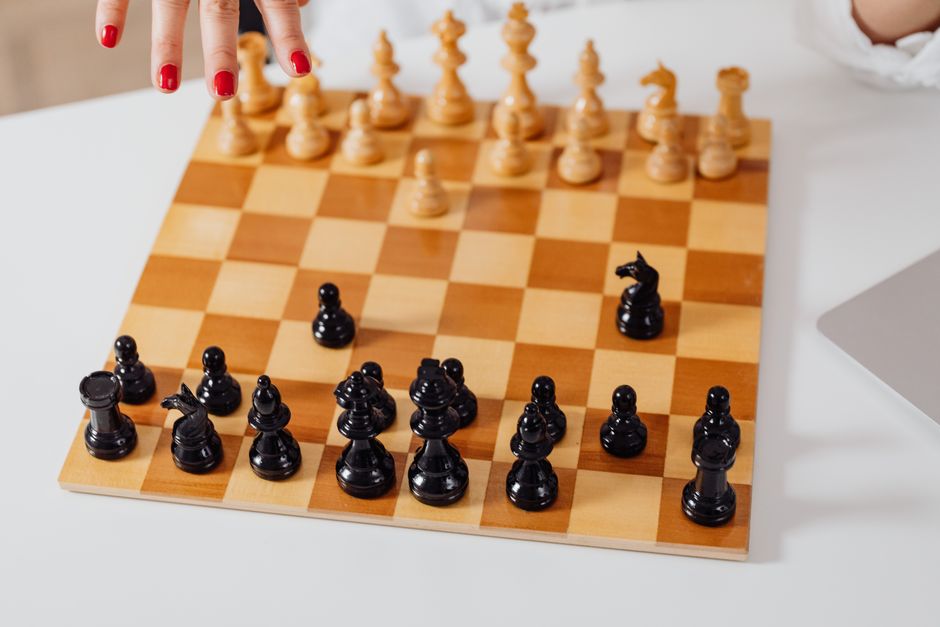
A few errors show up in beginner games again and again. Naming them helps you catch yourself.
Bringing the queen out early feels aggressive but backfires. The enemy develops pieces while attacking your exposed queen, gaining time and chasing her around the board for free.
Moving too many pawns wastes the opening. Each pawn move that does not fight for the center or open a line for a piece is a move your opponent spends developing an actual attacker.
Grabbing a poisoned pawn early can wreck you. Snatching a stray pawn while your king sits in the center often hands the opponent a fierce attack worth far more than one pawn.
Before every opening move, ask one question: "Does this develop a piece, control the center, or make my king safer?" If a move does none of the three, look for a better one.
Putting It Together
Here is what a principled opening looks like in practice. White plays 1. e4 to seize the center, 2. Nf3 to develop a knight and attack a pawn, 3. Bc4 or 3. Bb5 to develop a bishop, then castles kingside on move four or five.
That sequence checks every box: center, development, king safety — with no memorization required. Black can follow the same ideas symmetrically. From there, both sides have healthy positions and the real game begins.
Once your pieces are out and your king is castled, the next step is to connect your rooks and place them on open or half-open files. That transition from opening to middlegame is smooth when the first principles were followed, and awkward when they were not.
You will lose fewer games to opening disasters by internalizing these ideas than by memorizing twenty moves of a fashionable line. Theory matters later; principles matter now.
Practice the Habit
Play several games where your only goal is to obey the three principles — center, development, castling — and ignore everything else. Do not try to win in the opening; just reach a solid middlegame with your pieces out and your king safe.
After a dozen such games, principled openings become automatic and you will start recognizing when opponents break the rules so you can punish them. Strong opening play is not about memory — it is about good habits repeated until they feel like instinct.